At Your Beck and Call

For those clients who didn’t get enough love from their parents there can be an abiding need to please. As children they have had to internalise the neglect of their parents and make it their fault – as a survival tactic. Because you can’t objectively assess your parents as a young child — you need them for your continued existence. So the child may feel responsible for the mood of the parent.
In therapeutic terms this is called Defensive Caregiving – the child is looking after the parent in the hope that they will look after them better. It can mean the client grows up with a generalised feeling of responsibility for people and an acute radar for others’ moods and needs.
These qualities can to some extent work well for the client – making them likeable and popular, thoughtful and in tune with others. On the downside, It also makes it easier for partners/bosses/friends/colleagues to exploit and manipulate them if they are that way inclined.
In women, people pleasing can at times intersect with society’s expectation about wives and mothers being self-sacrificing and giving. For men, it may intersect with society’s need for them to be big and strong and take care of people.
It is not unusual for people to grow up with a people pleasing need. Their parents may have unintentionally created emotional neglect in their children’s lives owing to lack of capacity, drink or drug dependency, workaholism, poverty, depression, imprisonment, dissociation, carrying forward an inherited pattern.
People pleasing habits picked up in childhood
· To be good
· To please others
· To have radar for others’ moods
· To feel responsible for others
· To rely on partner being happy to feel okay
can be hard to shake.
These habits can leave people vulnerable to Narcissistic type characters testing out how far they can be pushed. In the run up to this boundary violation, you will likely been given a lot of warmth and flattery by the Narcissist – you’re in the love-bombing phase – and to your neglected child parts this is like an oasis in the desert. (See Blog entitled the Pizza and Candy Man)
The initial test from the Narcissist might be over something really small. For instance, they might
· cancel your arrangement to meet up and not apologize
· be snappy with you and then act like everything is fine
· share something with others you told them in confidence
Then, because you are really enjoying the relationship, you don’t pick them up on it. Instead, you question your own judgement:
· did I hear it right?
· Am I oversensitive? (This may be something you were told by parents.)
· I’m going to just laugh it off – nobody’s perfect
In the love-bombing stage with a Narcissistic character, you feel like you’re getting love and giving love, but what they are doing is gathering data. You have now given them the green light that they can violate your boundaries and there will be no comeback. When people look back on this kind of relationship, they often remember these early moments when they sensed something was ‘off’, but let it go as what the relationship was offering them at that time was too valuable – they were highly invested.
Before you know it (and this can be over months or over years) you find yourself at someone’s beck and call.
**Megan only had to hear her husband huffing and puffing to know what that he had seen some dirty dishes in the sink and she would need to clear them.
**George found himself rushing round clearing up when he heard his wife’s car in the driveway, in an attempt – which often failed – to avoid her critical eye when she walked in.
**Jeremy found he would rush to get his breakfast and get out of the house before his partner John got up and started hurling insults and him and the rest of the world
**Felicity’s partner Seren would only have to say, oh you didn’t put mushrooms in the risotto, for Felicity to be on her feet frying them, apparently having experienced no thought process at all.
The person pulling your strings – the controlling one – might be doing it by shouting, slamming doors and bashing furniture, or might be doing it very quietly with sighs and subtle digs. And sometimes both of these at different times.
When you are in a relationship like this, it can be very confusing to work out what is going on. You might turn to your partner for answers, but they will not be able to give you the validation you seek. They are more likely to project their poor behaviour on to you, confusing you further. Or dismiss your concerns. Or gaslight you in to believing they behave a lot better than you.
Support can be found opening up to others on what is happening, because controlling behaviour thrives in isolation. Practising mindfulness on yourself, so you see more clearly your responses and what is going on for you – meditating, journalling, going for walks, etc. Reading up on Narcissistic behaviour or individual therapy with a therapist who understands Narcissism (not couples’ therapy where the same dynamic can disorientate you further).
If you have one Narcissistic relationship in your life, there will be others most likely, at very least you may be prone to others, so it is worth investing in understanding your part in all of this - your vulnerability to this. The bonus about being at someone’s beck and call, is that you are generally the one most willing to change, moving towards more internal satisfaction with yourself and away from seeking outward approval.
**Client Confidentiality is paramount. Examples of Narcissist Survivors are never based on clients. Examples are created using a conglomerate of experiences of working in this area. This is done to protect the privacy of all clients.
*Note: I am not a psychiatrist thus not qualified to diagnose Narcissistic Personality Disorder.
What I have described in this Blog is a Narcissistic Personality Type.
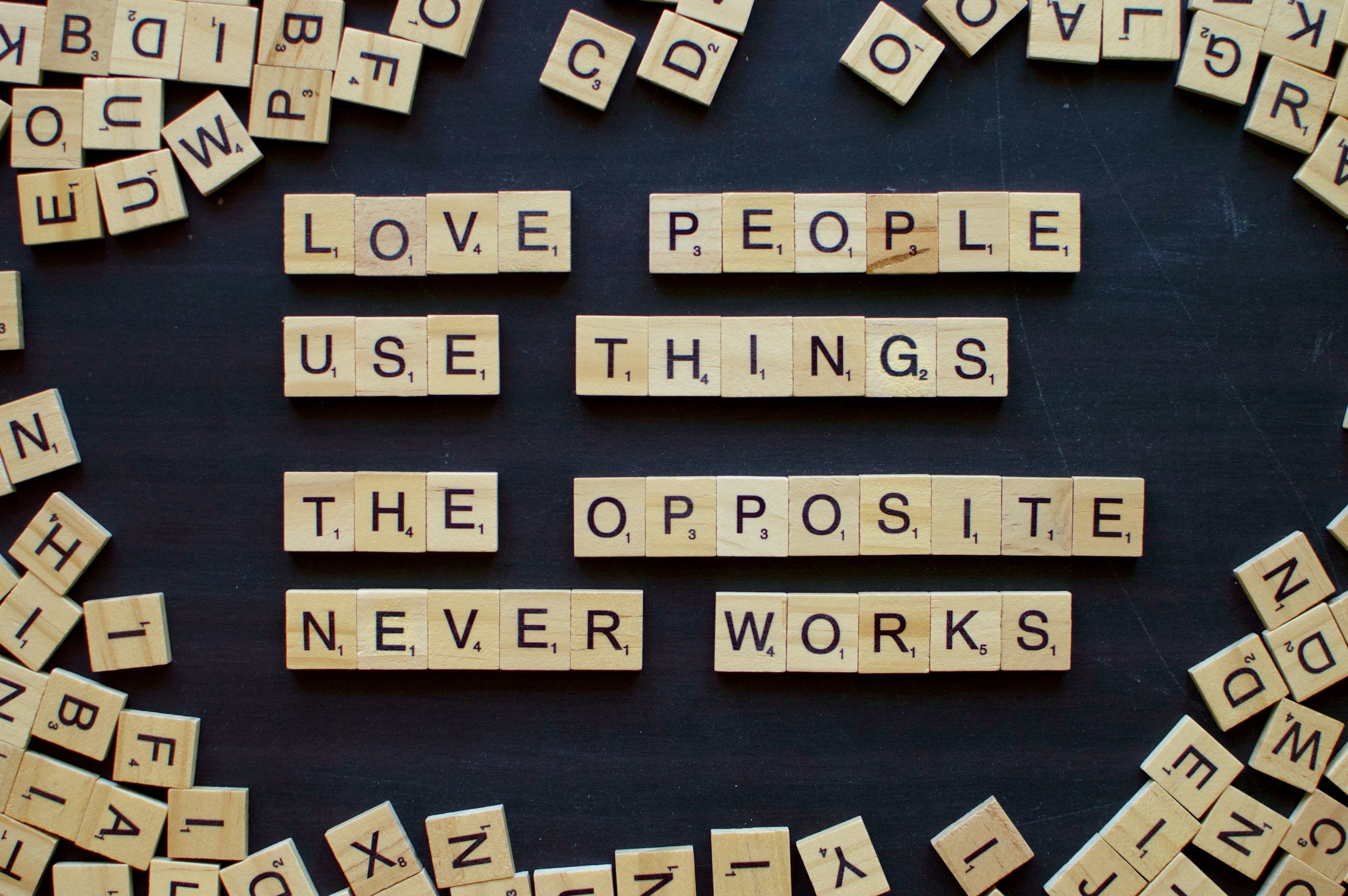
Using Scrabble pieces a phrase Love People Use Things